Visual Fault Locator K-V10
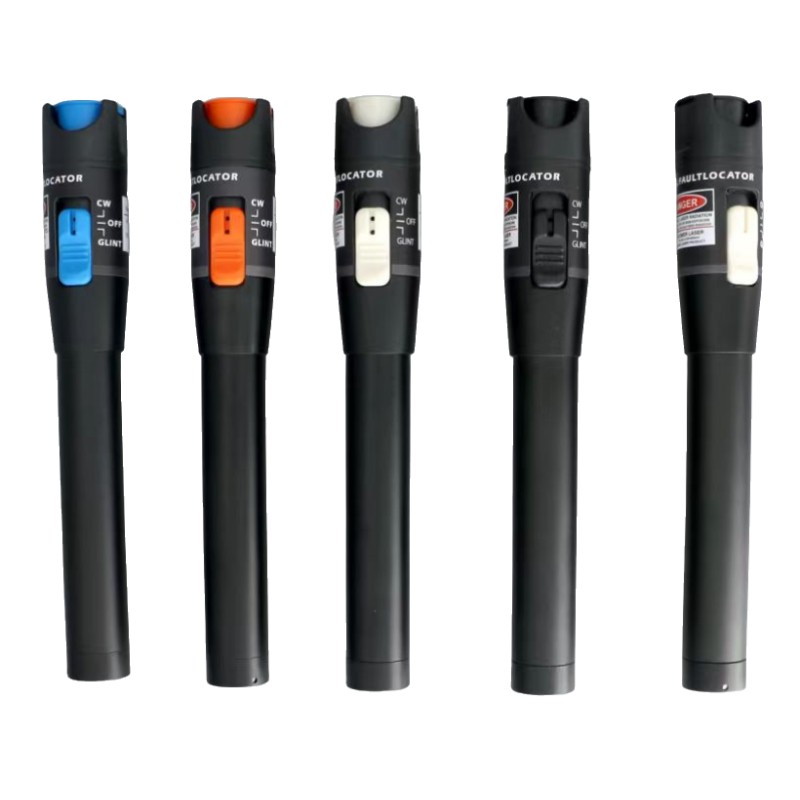
One pen body, six output powers from 1 mW to 30 mW: pick the light your link length needs, and breaks, bad bends and faulty connectors glow through the jacket.
Typical work: Finding breaks, crushed sections and over-tight bends in patch cords and pigtails; Checking continuity and polarity of jumpers before they go into service; Identifying one fiber in a bundle by its glow at the far end or at a bend; Locating faulty connectors and bad splices in closures and distribution boxes; Working the OTDR dead zone: the first metres an OTDR cannot see, the VFL can.
Get a Quote WhatsApp UsNeutral stock in small lots, or private label made to your requirements. Prices on request — EXW factory pricing.
K-V10 key features
- Six powers, one pen: 1 mW for the patch panel and short jumpers, where a stronger light just dazzles; 10 mW as the all-round field version; 15 to 30 mW for long distribution spans, where the light has kilometres of fiber to push through before it can leak out at the fault — same body, same universal connector, the power is the only difference
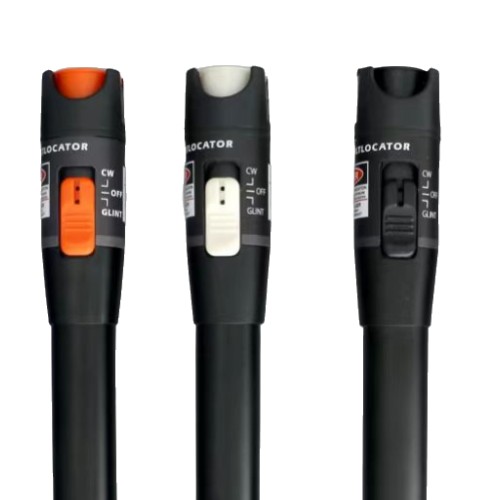
- Two modes on one slide switch: CW for a steady glow when you are tracing a cord, GLINT pulse at about 2 Hz when several cords glow nearby — the blinking one is yours, and the eye picks a pulse out of a bundle far better than a steady light
- Universal 2.5 mm connector takes FC, SC and ST ferrules directly — the pen walks from the ODF to the floor box to the customer's ONT without adapters; the same pen works on single-mode and multimode fiber
- Reference range runs from about 5 km at 1 mW to about 15 km at 30 mW on a continuous run — covering drop cables, distribution spans and in-building risers, with the exact reach set by the fiber and its losses
- Pen format with a dust cap and a battery LED beside the switch — green in normal operation, red when the two AA batteries run low, so the pen is swapped or re-celled before a trace, not during one: no warm-up, no menu, no manual, and it lives in the tool kit and the shirt pocket
- The classic OTDR companion: an OTDR cannot see the first metres past its own dead zone or tell you which pigtail in a tray is broken — thirty seconds with the pen answers both before the big instrument comes out
- Private labeling made to your requirements — labels with your logo, part numbers and barcodes on the inner boxes and outer cartons, ready for your warehouse
K-V10 specifications
| Output power | Six versions — 1 / 10 / 15 / 20 / 25 / 30 mW |
|---|---|
| Wavelength | 650 ± 10 nm (visible red) |
| Emitter | FP-LD laser diode |
| Modes | CW continuous / OFF / GLINT pulse (approx. 2 Hz), slide switch |
| Connector | Universal 2.5 mm — FC, SC and ST ferrules |
| Fiber types | Single-mode and multimode |
| Fault-location range | Reference: approx. 5 km at 1 mW to approx. 15 km at 30 mW, depending on fiber, losses and conditions |
| Power supply | 2 × AA (LR6) alkaline batteries |
| Battery indicator | LED beside the switch — green in normal operation, red when the batteries run low |
| Battery life | GLINT mode: over 40 h (1 mW), over 12 h (10 mW), over 10 h (top powers); roughly half in CW |
| Operating temperature | 0 °C to +60 °C |
| Storage temperature | -20 °C to +70 °C |
| Weight | 53 g (excluding batteries) |
| Dimensions | 175 × 26 × 26 mm |
How a visual fault locator finds the fault
The pen injects bright visible red light — 650 nm, the wavelength the eye is most sensitive to in a dark room — into the fiber. Where the fiber is intact, the light stays inside the core and travels. Where the glass is broken, sharply bent or badly joined, part of that light escapes through the side of the fiber, and because modern jackets and buffer tubes are translucent, the escape shows as a glowing red spot exactly at the fault. No glow at a connector means the loss there is small; a connector lit up like a lantern is the problem.
That is why the VFL is the first instrument out of the kit even when an OTDR is in the van: it answers the practical questions in seconds. Is this jumper continuous? Which of these twelve pigtails is the broken one? Did the drop cable survive the staple gun? Is the fault in this closure or further along? Follow the cord with your eyes; the light goes out or flares at the answer.
Choose the power for the run in front of you. The 1 mW pen is the patch-panel tool: on a two-metre jumper a stronger light adds glare, not information. The 10 mW pen is the general field version, good for drop cables and distribution work. The 15, 20, 25 and 30 mW pens exist for length: light fades as it travels, so on a long span the extra power is what still arrives at a break ten kilometres away with enough left to glow. Use the modes deliberately too — CW for a steady glow at close inspection, GLINT at about two pulses a second to pick your fiber out of a bundle or keep the light visible over distance.
Two habits keep the work safe and the tool alive. Never look into the end of a fiber or into the pen's port while it is on, and never view the output through a magnifier or inspection scope unless it is filtered for it — 10 mW of red laser is not a toy. Mind the battery polarity when you load the cells — reversed batteries leave the pen dead and can damage it. And keep the dust cap on when the pen is in the kit: the universal port's alignment sleeve is the accuracy of the instrument, and grit in it dims every test after.
Compare the fiber test equipment range
Every product in this category, side by side on the figures that decide the choice. Blank cells mean the figure is not stated in our current data — ask us and we will confirm it for the model you mean.
| K-527 | K-V10 | K-PV1 | K-340 | K-350 | K-535 | |
|---|---|---|---|---|---|---|
| Wavelength | — | 650 ± 10 nm (visible red) | — | — | — | — |
| Measurement range | -70 to +10 dBm | — | -70 to +10 dBm | — | — | -70 to +6 dBm or -50 to +26 dBm (two versions) |
| Dimensions | — | 175 × 26 × 26 mm | — | 219 × 45 × 28 mm | 196 × 30.5 × 27 mm | 118 × 72 × 32 mm |
| Weight | — | 53 g (excluding batteries) | — | 235 g | 200 g | 150 g |
Where the K-V10 works
Finding breaks, crushed sections and over-tight bends in patch cords and pigtails
Part of the Fiber Test Equipment range — see the specifications above for the figures that matter on this work.
Checking continuity and polarity of jumpers before they go into service
Part of the Fiber Test Equipment range — see the specifications above for the figures that matter on this work.
Identifying one fiber in a bundle by its glow at the far end or at a bend
Part of the Fiber Test Equipment range — see the specifications above for the figures that matter on this work.
Locating faulty connectors and bad splices in closures and distribution boxes
Part of the Fiber Test Equipment range — see the specifications above for the figures that matter on this work.
Working the OTDR dead zone: the first metres an OTDR cannot see, the VFL can
Part of the Fiber Test Equipment range — see the specifications above for the figures that matter on this work.
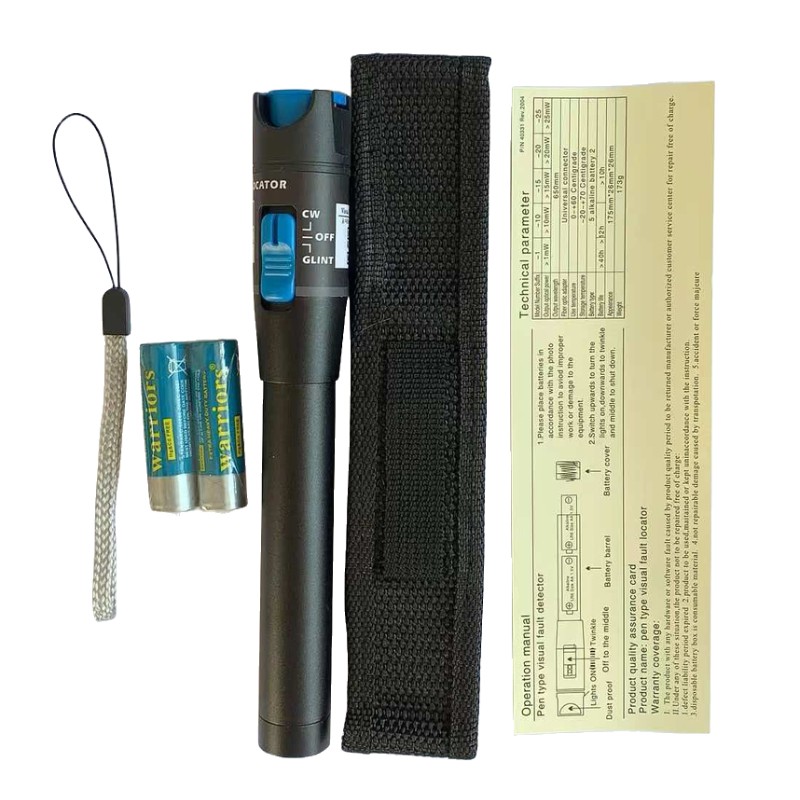
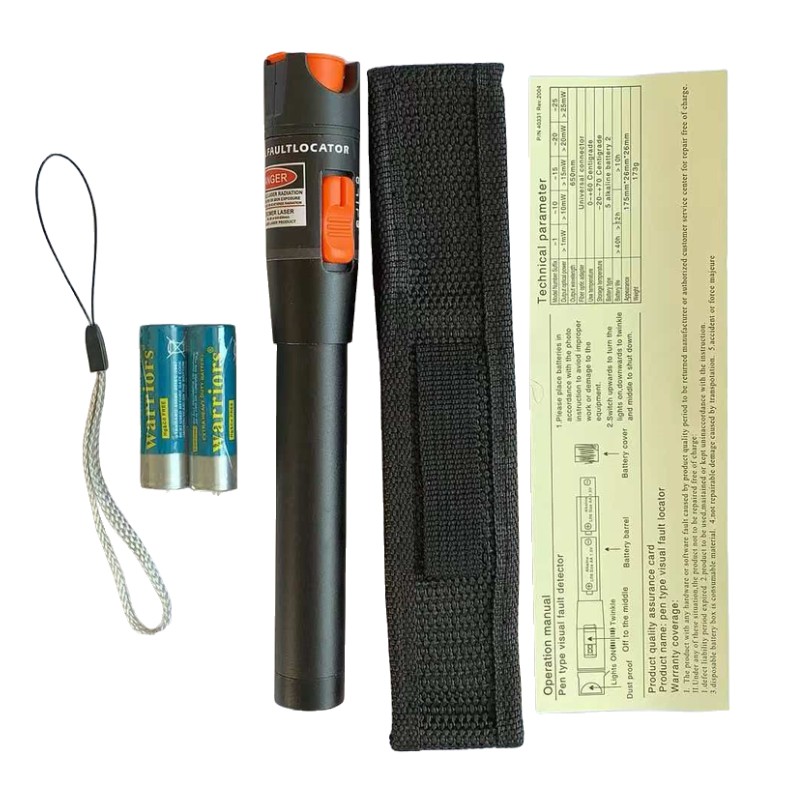
K-V10 components
- One K-V10 visual fault locator (power version as ordered)
- Belt pouch
- Wrist lanyard
- Operation manual
- 2 × AA batteries
Documents for this model
Product Catalog 2026 — this model appears in our full-range catalog (PDF), published in the Downloads center.
User manual — if you need the manual for this model now, ask via the inquiry form below or on WhatsApp and we will send the available documents with your quote.
More fiber test equipment
Questions about the K-V10
Can the K-V10 carry our own brand?
Private labeling is made to your requirements and confirmed per order — labels with your logo, part numbers and barcodes on the tools, the inner boxes and the outer cartons, ready for your warehouse. The products most often labeled are the K-35 cleaver, the KS-1 Kevlar shears and the K-870 stripper.
Can we order a small lot, unbranded?
Yes. Neutral stock is held for the core range: small lots are welcome, you can mix models in one shipment, and restock as you sell. Prices are on request — EXW factory pricing.
Ask for a quote — K-V10
Tell us the quantity, and whether you want it neutral or with your brand on it.