Optical Power Meter K-527
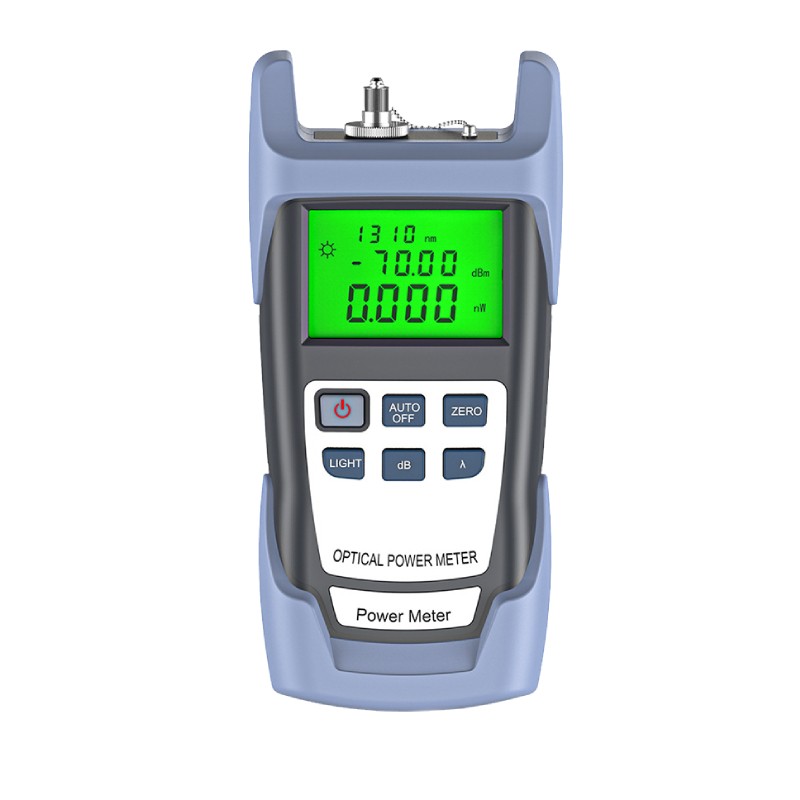
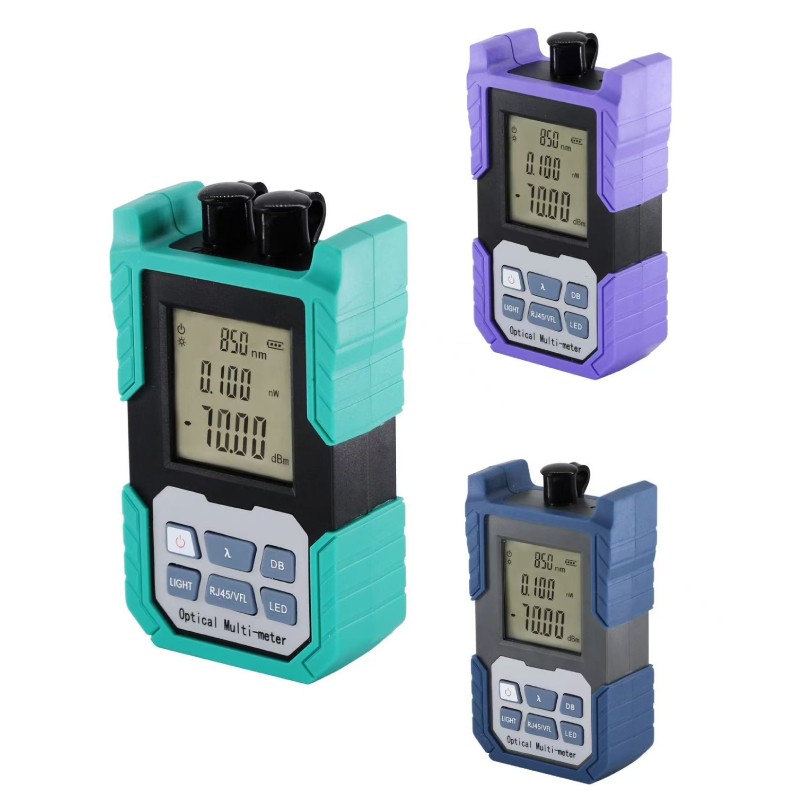
Absolute power and link loss on one backlit screen: -70 to +10 dBm across the seven wavelengths FTTH work actually uses, in a boot that shrugs off site knocks.
Typical work: Checking received power at the ONT during FTTH activation — the go / no-go number on every install; Measuring link and splitter loss with a light source, using the dB relative mode; Verifying transmitter output of ONUs, media converters and SFP modules; PON work at 1490 nm downstream and 1310 nm upstream; 1550 nm for RF-overlay and trunk checks; Acceptance records and fault triage: is the light weak at the source, or lost along the way?.
Get a Quote WhatsApp UsNeutral stock in small lots, or private label made to your requirements. Prices on request — EXW factory pricing.
K-527 key features
- -70 dBm sensitivity is the point of this meter: after a 1:32 splitter the signal at a customer's ONT can sit below -25 dBm, and a weak drop or a dirty connector pushes it far lower — a meter that stops at -50 cannot even see the light you are troubleshooting
- Seven calibrated wavelengths cover the working set: 1310 and 1490 for PON, 1550 for trunk and RF overlay, 1625 for in-service monitoring bends, 1300 and 850 for multimode premises work, 980 for pump and specialty links
- One screen, three readings: wavelength, absolute power in dBm and linear power in nW together, so there is no mode-hopping while a reading settles — and the backlight (LIGHT key) keeps it readable in a dark cabinet or a sunlit street box alike
- Relative loss the way installers actually use it: set ZERO on the source, and the dB key reads the loss of everything you plug in after it — splitter, splices and connectors as one number, comparable against the loss budget on the work order
- FC port on top with an SC adapter in the box, so the meter meets the plant as built; auto power-off after about ten minutes saves the batteries when a test ends in a hurry
- The meter rides in a silicone boot with raised guards around the port and screen: it is the difference between a knock on a ladder and a cracked instrument, and the boot is why this meter is still in kits years on
- Private labeling made to your requirements — labels with your logo, part numbers and barcodes on the inner boxes and outer cartons, ready for your warehouse
K-527 specifications
| Measurement range | -70 to +10 dBm |
|---|---|
| Calibrated wavelengths | 850 / 980 / 1300 / 1310 / 1490 / 1550 / 1625 nm |
| Wavelength range | 800–1700 nm |
| Detector | InGaAs |
| Uncertainty | ±5% |
| Display resolution | 0.01 dBm (logarithmic) / 0.1% (linear) |
| Display | Backlit LCD showing wavelength, dBm and linear power (nW) together |
| Functions | Absolute power (dBm / nW), relative loss (dB) with ZERO reference, backlight, auto power-off (about 10 min) |
| Connector | FC port; SC adapter included |
| Power supply | 2 × AA batteries |
| Housing | Meter in a protective silicone boot |
| Dimensions | — |
| Weight | — |
How a power reading is taken — and read
An optical power meter answers the simplest question in fiber work: how much light arrives here? It reports that as dBm — decibels against one milliwatt — where 0 dBm is a strong signal, -20 dBm is a healthy FTTH reading at the ONT, and every further -10 is a tenfold drop. The K-527 reads down to -70 dBm, deep past the point where service fails, so the number keeps talking while you hunt: clean a connector and watch it climb, swap a patch cord and watch it recover.
Absolute power is only half the instrument. Paired with a light source at the far end, the meter measures loss: set the reference with the ZERO key while connected straight to the source, then insert the link — splitter, splices, connectors — and the dB display reads everything the link took, as one figure. Compare it with the budget for that split ratio and span; over budget means the loss is in the plant, inside budget with a weak absolute reading means the problem is upstream of you.
Two settings decide whether the number means anything. Wavelength: the meter must be set to the wavelength being sent (the lambda key) — a 1490 nm PON signal read on the 1310 setting is off by a calibration offset, not by a little. And cleanliness: the detector window and the connector end-face are the measurement; a fingerprint on either is a loss you will chase into the plant. Clean, inspect, then measure.
Care is mostly about the port. Keep the dust cap on, blow out the adapter rather than wiping blind, and let the meter warm to the site for a minute in cold weather before trusting small differences. The auto-off exists because meters are forgotten on top of cabinets; the boot exists because they are also dropped off them.
Compare the fiber test equipment range
Every product in this category, side by side on the figures that decide the choice. Blank cells mean the figure is not stated in our current data — ask us and we will confirm it for the model you mean.
| K-527 | K-V10 | K-PV1 | K-340 | K-350 | K-535 | |
|---|---|---|---|---|---|---|
| Wavelength | — | 650 ± 10 nm (visible red) | — | — | — | — |
| Measurement range | -70 to +10 dBm | — | -70 to +10 dBm | — | — | -70 to +6 dBm or -50 to +26 dBm (two versions) |
| Dimensions | — | 175 × 26 × 26 mm | — | 219 × 45 × 28 mm | 196 × 30.5 × 27 mm | 118 × 72 × 32 mm |
| Weight | — | 53 g (excluding batteries) | — | 235 g | 200 g | 150 g |
Where the K-527 works
Checking received power at the ONT during FTTH activation — the go / no-go number on every install
Part of the Fiber Test Equipment range — see the specifications above for the figures that matter on this work.
Measuring link and splitter loss with a light source, using the dB relative mode
Part of the Fiber Test Equipment range — see the specifications above for the figures that matter on this work.
Verifying transmitter output of ONUs, media converters and SFP modules
Part of the Fiber Test Equipment range — see the specifications above for the figures that matter on this work.
PON work at 1490 nm downstream and 1310 nm upstream; 1550 nm for RF-overlay and trunk checks
Part of the Fiber Test Equipment range — see the specifications above for the figures that matter on this work.
Acceptance records and fault triage: is the light weak at the source, or lost along the way?
Part of the Fiber Test Equipment range — see the specifications above for the figures that matter on this work.
K-527 components
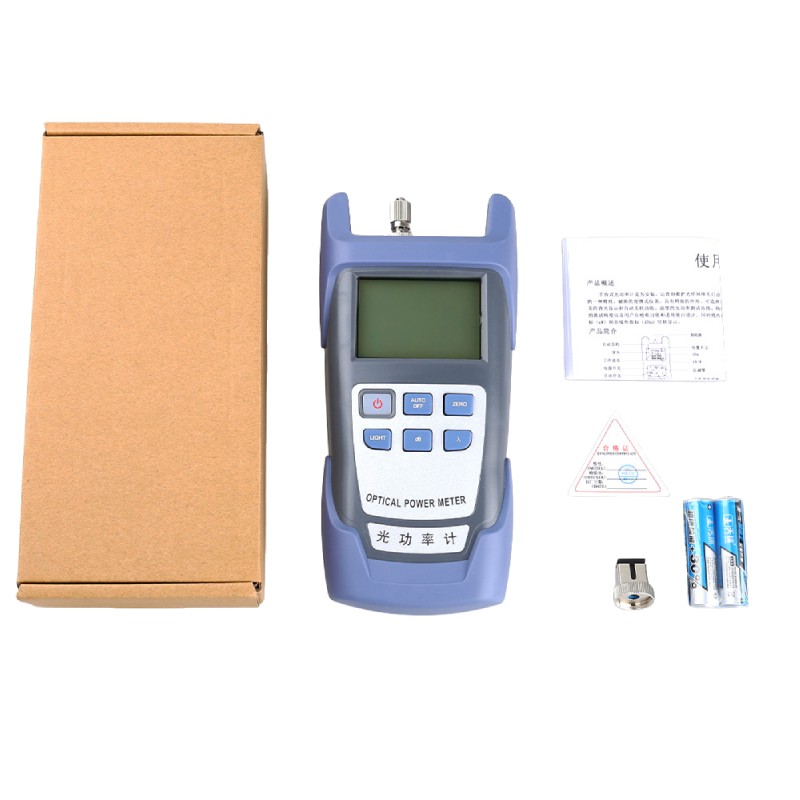
- One K-527 optical power meter in protective boot
- SC adapter
- 2 × AA batteries
- User manual
Documents for this model
Product Catalog 2026 — this model appears in our full-range catalog (PDF), published in the Downloads center.
User manual — if you need the manual for this model now, ask via the inquiry form below or on WhatsApp and we will send the available documents with your quote.
More fiber test equipment
Questions about the K-527
Can the K-527 carry our own brand?
Private labeling is made to your requirements and confirmed per order — labels with your logo, part numbers and barcodes on the tools, the inner boxes and the outer cartons, ready for your warehouse. The products most often labeled are the K-35 cleaver, the KS-1 Kevlar shears and the K-870 stripper.
Can we order a small lot, unbranded?
Yes. Neutral stock is held for the core range: small lots are welcome, you can mix models in one shipment, and restock as you sell. Prices are on request — EXW factory pricing.
Ask for a quote — K-527
Tell us the quantity, and whether you want it neutral or with your brand on it.