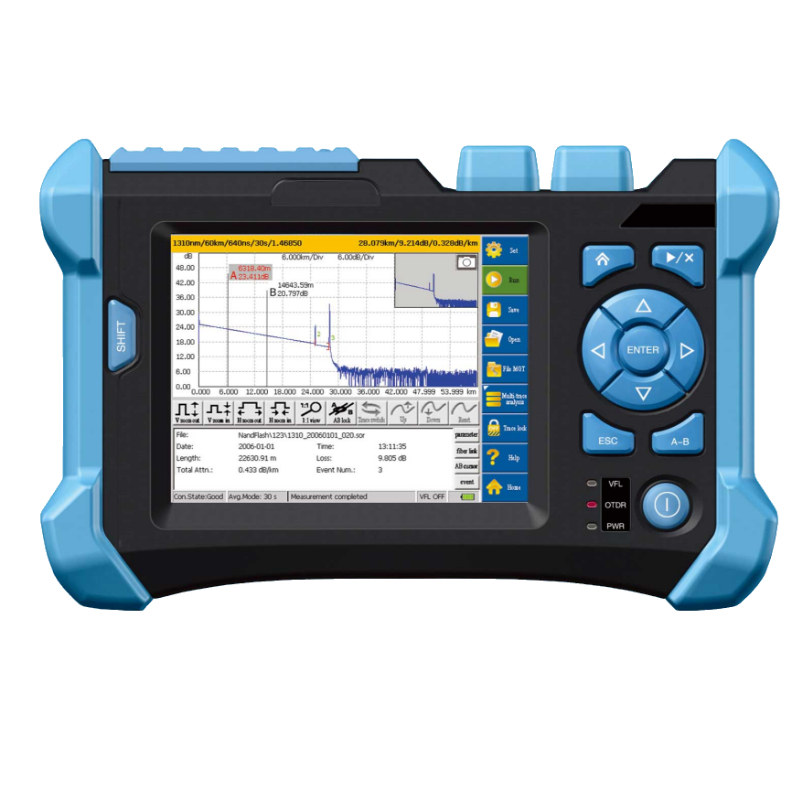
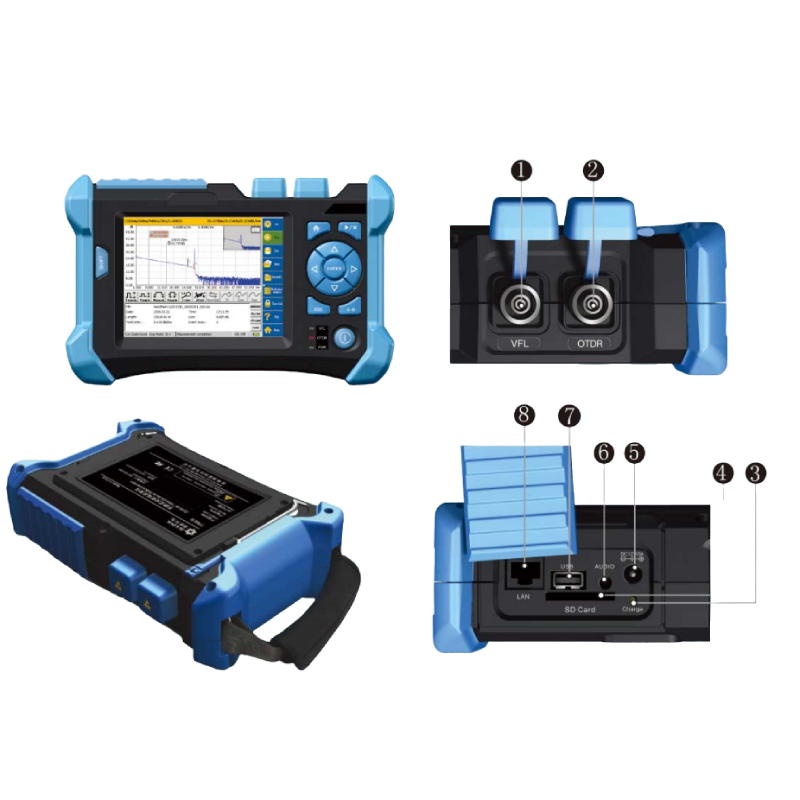
OTDR K-600
A platform OTDR for FTTx, metro and backbone work: choose the wavelength set and dynamic range the network needs, read it on a 5.6-inch touch screen, and keep more than 10,000 traces on the SD card.
Typical work: FTTx and PON acceptance testing — verifying splitters, drops and splice points before handover; Metro and backbone construction: certifying new spans and archiving reference traces; Fault location on live networks — breaks, bends and bad connectors found from one end; Live-fiber monitoring with the 1625 nm configuration, clear of the traffic wavelengths; Periodic maintenance comparison of today's trace against the as-built reference.
Get a Quote WhatsApp UsNeutral stock in small lots, or private label made to your requirements. Prices on request — EXW factory pricing.
K-600 key features
- Configurations, not compromises: single-mode 1310/1550 nm at 32/30, 38/36 or 40/38 dB, triple-wavelength 1310/1490/1550 nm for PON work, a 1625 nm build for live-fiber monitoring, and multimode 850/1300 nm — one platform, specified per order
- Short dead zones for dense plant: event dead zone at or under 1.8 m and attenuation dead zone at or under 10 m, so connectors and splices packed into a cabinet or closure still separate on the trace
- Fast in the field: 0.2 s typical real-time refresh, intelligent one-touch testing, measurement times from 5 seconds to 3 minutes, and a built-in 650 nm VFL (up to 3 km) for the short visible checks
- Built to be carried: dustproof, shockproof casing at 1.5 kg, a lithium battery good for eight hours or more, and traces stored on SD card and moved over USB or Ethernet
K-600 specifications
| Wavelength options | 850/1300 nm (multimode); 1310/1550 nm; 1310/1490/1550 nm; 1625 nm |
|---|---|
| Dynamic range | Up to 40/38 dB (1310/1550 nm) — by build; see the model table |
| Pulse width | 5–20480 ns (single-mode); 5–1280 ns (multimode) |
| Event dead zone | ≤1.8 m |
| Attenuation dead zone | ≤10 m |
| Display | 5.6 in LCD touch screen |
| Linearity | ±0.05 dB/dB |
| Loss threshold | 0.05 dB |
| Loss resolution | 0.001 dB |
| Sampling resolution | 0.125–8 m |
| Sampling points | 32K |
| Distance uncertainty | ±(1 m + 5×10⁻⁵ × distance + sampling interval) |
| Distance range | 0.3–180 km |
| Real-time refresh | 0.2 s (typical) |
| Trace storage | SD card (16 G), >10,000 traces |
| Measurement duration | 5 s, 10 s, 15 s, 30 s, 1 min, 2 min, 3 min (selectable) |
| Optical interface | FC/UPC (PC and APC selectable) |
| Data interfaces | USB, SD card, Ethernet |
| Built-in VFL | 650 nm, ≥-3 dBm, max. testing distance 3 km |
| Battery | Lithium battery, ≥8 h continuous working |
| Dimensions | 150 × 235 × 66 mm |
| Weight | 1.5 kg |
| Operating temperature | -10 °C to +50 °C |
| Storage temperature | -30 °C to +70 °C |
| Relative humidity | 0–95% (non-condensing) |
How an OTDR read works — and where the K-600 earns its keep
The OTDR sends a pulse of light down the fiber and listens to what comes back: a faint reflection from every connector and mechanical splice, the steady backscatter of the glass itself, and a hard spike at a break or the fiber end. Plotted against distance, that returning light becomes the trace — slope for attenuation, steps and spikes for events — and the instrument turns it into a table of lengths, losses and fault positions without anyone visiting the far end.
Two numbers decide whether close-together events can be told apart: the event dead zone (≤1.8 m here) and the attenuation dead zone (≤10 m). In a distribution cabinet where connectors sit centimetres apart, a long dead zone hides the second connector inside the first one's tail; the K-600's short zones keep them separate. Range is the other trade: pulse width runs from 5 ns for fine detail to 20480 ns for reach, and the distance scope tops out at 180 km — pick the configuration whose dynamic range covers the link budget, because an oversized OTDR buys range you will never use at the cost of the close-up resolution you need every day.
Choose your K-600 model
One platform, several builds. Pick the wavelength set and dynamic range for your network, and quote the model code with your inquiry — we confirm the build and lead time with your quote.
| Model | Wavelengths | Fiber | Dynamic range | VFL |
|---|---|---|---|---|
| K-600-M1 | 850/1300 nm | Multimode | 20/18 dB | Built-in |
| K-600-M2 | 850/1300 nm | Multimode | 23/21 dB | Built-in |
| K-600-S1 | 1310/1550 nm | Single-mode | 32/30 dB | Built-in |
| K-600-S2 | 1310/1550 nm | Single-mode | 38/36 dB | Built-in |
| K-600-S3 | 1310/1550 nm | Single-mode | 40/38 dB | Built-in |
| K-600-P1 | 1310/1490/1550 nm | Single-mode | 32/30/30 dB | Built-in |
| K-600-P2 | 1310/1490/1550 nm | Single-mode | 36/34/34 dB | Built-in |
| K-600-L1 | 1310/1550/1625 nm | Single-mode | 32/30/28 dB | — |
| K-600-L2 | 1310/1550/1625 nm | Single-mode | 38/36/34 dB | — |
| K-600-C1 | 850 + 1310/1550 nm | Multimode + single-mode | 22/30/28 dB | — |
| K-600-C2 | 850/1300 + 1310 nm | Multimode + single-mode | 20/18/30 dB | — |
| K-600-C3 | 850 + 1310/1550 nm | Multimode + single-mode | 25/30/28 dB | — |
| K-600-C4 | 850/1300 + 1310 nm | Multimode + single-mode | 23/21/30 dB | — |
| K-600-C5 | 850/1300 + 1310/1550 nm | Multimode + single-mode | 20/18/30/28 dB | — |
Where the K-600 works
FTTx and PON acceptance testing — verifying splitters, drops and splice points before handover
Part of the Fiber Test Equipment range — see the specifications above for the figures that matter on this work.
Metro and backbone construction: certifying new spans and archiving reference traces
Part of the Fiber Test Equipment range — see the specifications above for the figures that matter on this work.
Fault location on live networks — breaks, bends and bad connectors found from one end
Part of the Fiber Test Equipment range — see the specifications above for the figures that matter on this work.
Live-fiber monitoring with the 1625 nm configuration, clear of the traffic wavelengths
Part of the Fiber Test Equipment range — see the specifications above for the figures that matter on this work.
Periodic maintenance comparison of today's trace against the as-built reference
Part of the Fiber Test Equipment range — see the specifications above for the figures that matter on this work.
K-600 components
- One K-600 OTDR (configuration as ordered)
- Lithium battery (fitted)
- Power adapter / charger
- SD card
- Carry case
Documents for this model
Product Catalog 2026 — this model appears in our full-range catalog (PDF), published in the Downloads center.
User manual — if you need the manual for this model now, ask via the inquiry form below or on WhatsApp and we will send the available documents with your quote.
More fiber test equipment
Questions about the K-600
Can the K-600 carry our own brand?
Private labeling is made to your requirements and confirmed per order — labels with your logo, part numbers and barcodes on the tools, the inner boxes and the outer cartons, ready for your warehouse. The products most often labeled are the K-35 cleaver, the KS-1 Kevlar shears and the K-870 stripper.
Can we order a small lot, unbranded?
Yes. Neutral stock is held for the core range: small lots are welcome, you can mix models in one shipment, and restock as you sell. Prices are on request — EXW factory pricing.
Ask for a quote — K-600
Tell us the quantity, and whether you want it neutral or with your brand on it.